


How do skin boosters differ by ingredient?
2026.11.24Related procedures
“Skin booster” is an umbrella term for a range of ingredients and treatments, so the changes you can expect and the precautions to take may differ depending on the ingredient. Hyaluronic acid (HA), which holds on to moisture; polynucleotides (PN), which act on the skin’s underlying tissue; and poly-D,L-lactic acid (PDLLA), which is known to help stimulate collagen production, differ in their goals, when changes appear, and the precautions involved.
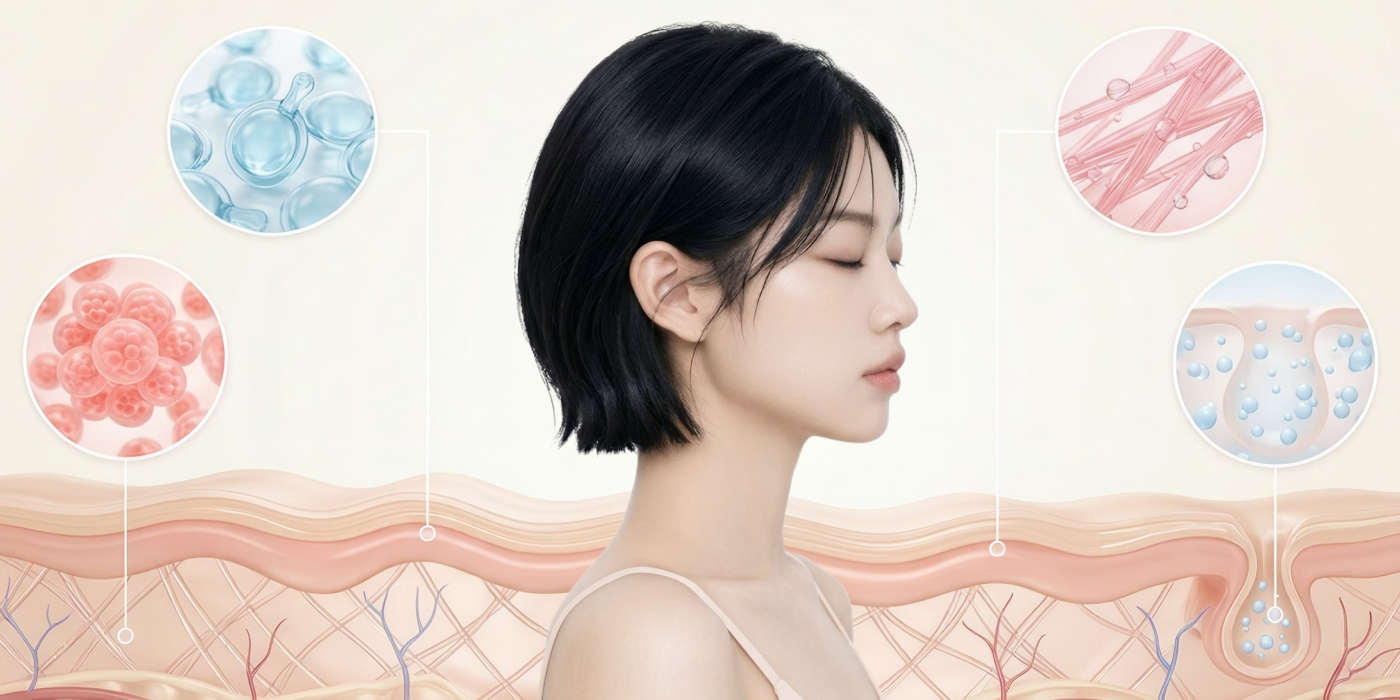
Therefore, rather than asking which ingredient is best, it is important to first decide what you want to improve most: dryness, skin texture, elasticity, or pores.
What does “skin booster” refer to?
“Skin booster” is closer to an umbrella term for various treatments injected into the dermis and surrounding layers to improve skin conditions such as hydration, radiance, elasticity, fine lines, and pores. Even with the same ingredient, results and the likelihood of side effects can differ if the molecular size, whether the components are cross-linked, the concentration, any added ingredients, and the injection depth and spacing differ.
To understand a treatment accurately, it is therefore best to look at other conditions as well as which ingredient was injected. Only by checking the exact product and ingredients, approved uses, the skin layer injected, the amount used per session, and the number of sessions can you compare research results with the actual treatment.
Changes you can expect by ingredient
Hyaluronic acid (HA) and changes in hydration and elasticity
Hyaluronic acid is an ingredient that attracts water. Products for improving skin condition are often made with lower viscosity and elasticity than volumizing fillers so that they spread widely. In a randomized clinical study of 25 people in which hyaluronic acid was injected once into only one lower cheek, hydration on the injected side was higher than on the uninjected side from week 2 through the 12-week observation period, and elasticity also appeared to improve.
However, this study involved 25 people at a single hospital using a specific injection device, and the comparison was the side that received no injection. It is therefore reasonable to understand that the duration and effects may differ from one hyaluronic acid product to another. Hyaluronic acid may be considered if you want to improve dryness, fine skin texture, or hydration.
Polynucleotides (PN) and changes in skin texture and elasticity
Polynucleotides are ingredients in the form of relatively long chains. At clinics, the name is sometimes used interchangeably with polydeoxyribonucleotide (PDRN), but their molecular size, formulation, and approved products are not the same, so it is best to distinguish between them.
In a clinical study of 27 people comparing polynucleotides with non-cross-linked hyaluronic acid (hyaluronic acid not treated to link its molecules together) injected around the eyes, there was no clear difference in overall improvement scores after three sessions. Both sides improved, and at some assessment time points, the side injected with polynucleotides showed greater improvement in elasticity and hydration, as well as greater improvement in roughness and pore measures. However, the degree of improvement decreased on both sides over time.
These results come from a specific area, around the eyes, and a specific treatment method. More research is therefore needed to determine whether polynucleotides are better than hyaluronic acid for all purposes. Polynucleotides may be considered if you want to improve skin texture, elasticity, or roughness in areas with thin skin, such as around the eyes, and because some products use raw materials derived from fish, it is best to check your allergy history as well.
Poly-D,L-lactic acid (PDLLA) and gradual collagen changes
Poly-D,L-lactic acid consists of microscopic particles that break down slowly in the body, and it helps new collagen form through the skin tissue’s response. Products formulated together with hyaluronic acid aim for both initial hydration and skin changes that appear over time.
In an early study in which 16 people received 2–3 sessions, fine lines, skin texture, and overall signs of aging improved, and skin biopsies taken from behind the ear in some participants who consented showed increases in collagen and elastic fibers.
However, the study had few participants and no comparison group. Evidence on its effects compared with other ingredients has therefore not yet sufficiently accumulated. In addition, small bumps or nodules may form depending on the dilution, injection depth, and distribution, so the practitioner’s experience is important. Poly-D,L-lactic acid may be considered if you want gradual changes in elasticity and skin density rather than hydration.
Ingredients to consider by skin concern
Are tightness and dryness your biggest concern?
Hyaluronic acid–based products are directly related to improving dryness. However, if a skin barrier disorder or inflammation is the cause, treating the cause and moisturizing care may need to come before injection treatments.
Concerned about thin, crinkly skin texture around the eyes?
You can compare polynucleotides with low-viscosity hyaluronic acid. It is best to consider whether the area around your eyes swells easily, whether you have allergies, and whether your bruises tend to last long, and to clarify whether the change you want is in hydration or elasticity.
Are pores and oiliness your main concern?
Pores are affected not only by sebum but also by scarring, loss of elasticity, and hair follicle structure, so the appropriate care differs depending on the cause. It is best to have your skin condition assessed first and then decide on an approach with a medical professional.
Want better elasticity and density, even if changes appear slowly?
You can consider ingredients known to help stimulate collagen production, such as poly-D,L-lactic acid. You should expect changes over several months rather than immediate results, and it is best to also review with a medical professional how nodules would be managed if they form.
Why it is hard to compare ingredients by duration alone
Each study differs in product, concentration, injection volume, number and interval of sessions, area treated, and assessment devices. Even if research results cite figures such as 3 or 6 months, they may not come from direct comparisons under the same conditions. In particular, it may not be appropriate to rank ingredients by placing one study’s improvement in hydration side by side with another study’s patient satisfaction.
It is therefore important to look together at when changes begin, which measures improved, how many sessions the results are based on, and what happens as the effect wears off.
Possible side effects after skin booster treatment
- With any ingredient, pain, redness, swelling, bruising, temporary bumpy swelling of the skin (embossing), and infection can occur.
- Hyaluronic acid can cause long-lasting swelling or nodules and, rarely, vascular complications.
- Polynucleotides can cause allergies related to their raw materials, as well as swelling or small bumps at the injection site.
- Poly-D,L-lactic acid can cause small bumps or nodules to form over time, or it may not spread evenly. Rare complications involving blocked blood vessels have been reported.
If you experience severe pain, color changes in which the skin turns white or develops a net-like pattern, vision problems, or swelling or warmth that worsens rapidly, do not wait it out assuming it is ordinary bruising or embossing; contact the clinic where you were treated or an emergency care facility without delay.
Points to review with a medical professional during your consultation
- Check the product’s exact name, main ingredients, and approved uses in Korea.
- Check whether there is clinical evidence assessed using the same measures as your concern.
- Check how many sessions, and at what intervals, the explanation is based on, rather than a single session.
- If other ingredients are mixed in, check which ones and why.
- Check how nodules or vascular problems would be handled if they occur.
Rather than expecting a single skin booster to improve hydration, texture, elasticity, and pores all at once, it is best to first understand that each ingredient suits different concerns. This is because each ingredient has different research results and limitations.
Therefore, it is important to first identify your one or two most important skin concerns and then choose, with a medical professional, the ingredients and treatment methods supported by evidence for those concerns.
Frequently Asked Questions
- How should I choose a skin booster ingredient?
- Rather than going by ingredient name, it is best to choose a skin booster after reviewing with a medical professional the cause of your skin concern and the approved purpose and evidence for the product that will actually be used. Even with the same ingredient, results can differ depending on the product, concentration, and injection depth. Swelling, bruising, delayed nodules, and other effects may occur, and there are also rare complications involving blocked blood vessels, so get a detailed explanation from a medical professional before treatment.
- Which skin booster can be considered for dry, tight skin?
- Hyaluronic acid (HA)–based products can be considered, and there are research findings showing increased skin hydration. In a small randomized study in which one product was injected once into only one cheek in 25 people, hydration on the injected side was higher than on the uninjected opposite side at the 2-, 4-, 8-, and 12-week assessments, and elasticity also improved. If itching, flaking, or redness is also present, treating the cause and moisturizing come first, and swelling, nodules, or rare complications involving blocked blood vessels may occur, so get a detailed explanation from a medical professional before treatment.
- Are polynucleotides (PN) and PDRN the same thing?
- They are not the same; in Korea, PN-based medical devices and PDRN-based prescription drugs exist as separate products. Major injectable products use DNA components derived from fish such as salmon and trout, but the exact raw materials, formulation, and approved purpose should be checked for each product. If you have a fish allergy or have had a hypersensitivity reaction to an injectable before, tell your medical provider before treatment.
- When do the effects of a poly-D,L-lactic acid (PDLLA) skin booster appear?
- Changes from poly-D,L-lactic acid (PDLLA) may appear gradually over weeks to months, and there are research findings in which fine lines and skin texture improved after treatment and increases in collagen and elastic fibers were observed. This was an early study in which 16 people received 2–3 sessions of a product combining PDLLA and hyaluronic acid, and the collagen changes were confirmed in skin from behind the ear in some participants who consented to a biopsy. Delayed nodules or rare complications involving blocked blood vessels may occur, so get a detailed explanation from a medical professional before treatment.
- Are there symptoms after skin booster treatment that mean I should contact the clinic right away?
- If you experience vision problems, difficulty breathing, or swelling of the lips or tongue, call 119 (the emergency number in Korea) or go to the emergency room immediately, and also notify the clinic where you were treated. Severe pain, or skin that turns white or develops a net-like discoloration, may be a sign of a vascular problem and requires care without delay, while fever, pus, or rapidly worsening redness or warmth requires same-day care. Do not wait it out assuming these symptoms are ordinary bruising or temporary swelling.
References
- 1.Lee YJ, Kim HT, Lee YJ, et al. Comparison of the effects of polynucleotide and hyaluronic acid fillers on periocular rejuvenation: a randomized, double-blind, split-face trial. J Dermatolog Treat. 2022;33(1):254-260.
- 2.Roh NK, Kim MJ, Lee YW, Choe YB, Ahn KJ. A Split-Face Study of the Effects of a Stabilized Hyaluronic Acid-Based Gel of Nonanimal Origin for Facial Skin Rejuvenation Using a Stamp-Type Multineedle Injector: A Randomized Clinical Trial. Plast Reconstr Surg. 2016;137(3):809-816.
- 3.Seo SB, Park H, Jo JY, Ryu HJ. Skin rejuvenation effect of the combined PDLLA and non cross-linked hyaluronic acid: A preliminary study. J Cosmet Dermatol. 2024;23(3):794-802.
Medical Mentor
 Dr. Jang Hyun Ji
 Dr. Lee Song


