


Is blocking UV enough to manage melasma?
2026.10.20Sun protection is fundamental to melasma care, but applying a product with a high sun protection factor (SPF) alone may not be enough to manage sun exposure. Visible light in sunlight can also cause pigment changes in people whose skin darkens easily and in people with melasma. That is why a tinted product containing iron oxide pigments may be more helpful than an untinted sunscreen.

SPF 50+ does not indicate how much visible light is blocked, so if you have melasma, it is important to consider all the sunlight that reaches your face, not just UV.
What kinds of light are in sunlight?
Ultraviolet B (UVB) is mainly associated with sunburn, and SPF indicates how well a product blocks it. Ultraviolet A (UVA) penetrates deeper into the skin and is involved in skin aging and pigment changes; protection against it is indicated by the UVA protection grade (PA) or a UVA label. The range of longer wavelengths beyond that, 400–700 nm, is visible light, which we perceive as color.
Visible light is light we can see, but it can also affect the skin. In an experiment in which visible light was applied to the buttock skin of healthy adults, people with darker skin showed immediate darkening as well as tanning that appeared over time, while lighter skin showed no clear pigment change. After repeated exposure, gene changes related to pigment production, cell damage, and changes in skin tissue were also identified. However, the degree of skin response varies greatly depending on the wavelength and amount of light and on skin type.
In a study that applied blue light to normally sun-protected skin of 21 women with melasma and 21 healthy women, pigmentation developed in both groups; at 20 J/cm², the change was actually smaller in the melasma group, and at 40–80 J/cm², the two groups were similar. However, this study did not directly evaluate melasma areas on the face. Further research targeting facial melasma areas is therefore needed to determine whether people with melasma respond more strongly to visible light.
Why melasma is difficult to manage
Melasma is not simply a spot with excess melanin; it is a long-lasting, easily recurring skin condition in which the skin surface, the dermis, blood vessels, and inflammatory signals are all involved. Even after it fades with treatment, it can darken again if sun exposure continues. Daily, consistent sun protection is therefore the foundation of long-term care, more than any single treatment.
It is best to understand visible light as one of the easily overlooked factors among the many involved in melasma, including UV, hormones, and genetic factors.
How do untinted and tinted sunscreens differ?
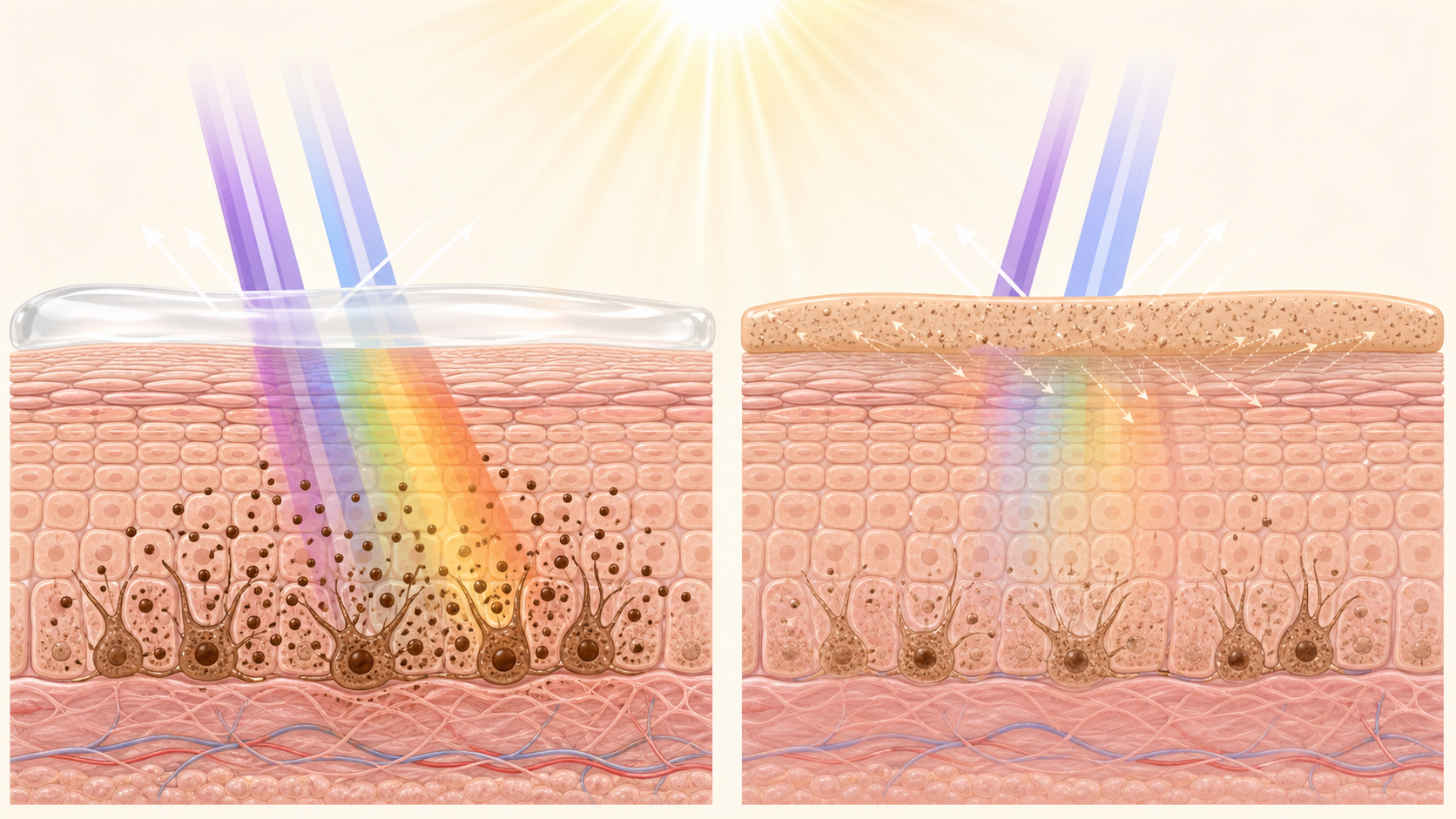
Most organic UV filters are designed to absorb light in the UV range and do not sufficiently block visible light. Products using zinc oxide and titanium dioxide may also have a limited ability to block visible light when their particles are made small so they look transparent on the skin.
The iron oxides that give tinted products their color absorb and scatter visible light. They do not block all visible light, but they can provide an extra layer of filtering compared with untinted products. Therefore, rather than only looking at whether a sunscreen is mineral (physical) or organic (chemical), checking whether it protects against both UVA and UVB and whether it contains iron oxide pigments may be more helpful for managing melasma.
Research on tinted sunscreens
A 2014 clinical study randomly divided 68 people with melasma (61 completed) into two groups, with neither participants nor researchers knowing which product was used, and compared two products with SPF 50 or higher. Both groups also used 4% hydroquinone; one group used an iron oxide–containing product designed to block both UV and visible light, and the other group used a product that blocks only UV. After 8 weeks, the group using the product that blocks both UV and visible light showed greater improvement in the melasma severity score (MASI), skin color measurements, and melanin assessment of skin tissue.
However, because both groups also used a lightening treatment, the therapeutic effect of the tinted sunscreen alone was not separately confirmed. It is therefore appropriate to view this study as evidence that sun protection that also accounts for visible light may help results during the same treatment.
In a clinical study published in 2025, 42 women with melasma (41 completed) used either a tinted or an untinted product for 5 months during summer, and only the tinted group showed a statistically significant reduction in the color difference between melasma areas and the surrounding skin. However, the modified melasma severity score (mMASI) improved in both groups, with no statistically significant difference between them, and the manufacturer funded the study and also took part as investigators. The effect of tinted products therefore needs to be followed through future research alongside these results.
What to check when choosing a sunscreen
- Check that the product has an adequate SPF and a UVA protection label, so it protects against both UVA and UVB.
- In the ingredient list, you can look for iron oxide pigments labeled as iron oxides or as CI 77491, 77492, or 77499.
- Rather than a shade so light or dark that it makes you apply less, it is best to choose a shade you can apply generously every day.
- Formulas that sting skin with melasma or need to be rubbed in may be hard to use consistently.
- If you sweat a lot or spend a lot of time outdoors, it is also good to check whether the formula is water-resistant and easy to reapply.
How should you apply sunscreen?
Applying an ample amount, rather than a single thin layer, helps you get the protection the product is designed to provide. Apply it evenly to your face and other sun-exposed areas before going out, and reapply after sweating, getting wet, or rubbing, or after spending a long time outdoors. Wide-brimmed hats, parasols, and shade are ways to reduce both UV and visible light.
If it is hard to reapply over makeup, you can apply a thin layer of the same type of tinted product or use a cushion-type product as a supplement. However, a few pats of a cushion should be seen as a supplementary measure, and the sunscreen you apply in the morning should still be applied in an ample amount.
Does blue light from smartphone screens affect melasma?
The main evidence covered in this column comes from studies using sunlight or light controlled in a laboratory. Smartphones and monitors also emit visible light, but there is not yet enough clinical evidence to treat everyday screen use as equivalent to outdoor sunlight or as a major cause of melasma. Rather than worrying about screen use, it is therefore better to first manage your exposure to outdoor sunlight and sunlight through windows.
Caution is warranted in regarding visible light as a major cause of melasma, but it is better to consider sunlight as a whole rather than blocking only UV. In melasma care, the goal of sun protection is not to shield the skin completely from light, but to reduce the sun exposure that accumulates every day.
Therefore, it is important to consider applying an ample amount of a product that protects against both UVA and UVB and reapplying it, along with using a tinted product containing iron oxide pigments, hats, and shade. It is best to review the condition of your melasma and treatment options with a medical professional.
Frequently Asked Questions
- Is SPF 50+ sunscreen alone enough to manage melasma?
- An SPF 50+ label alone makes it hard to judge whether your sun protection is sufficient for melasma, so it is best to also check for a UVA protection label and supplement visible light protection with a tinted sunscreen containing iron oxides. SPF mainly indicates the level of UVB protection, and visible light can worsen melasma, especially in people whose skin darkens easily. Apply an ample amount, reapply about every 2 hours outdoors and right after sweating, getting wet, or rubbing, and also use hats, parasols, and shade.
- Do tinted sunscreens also block visible light?
- Tinted sunscreens containing iron oxides help block visible light, but they do not block all of it, and protection varies from product to product. An ingredient list showing iron oxides or CI 77491, 77492, or 77499 only tells you that iron oxides are present, not how much visible light is blocked. Choose a product whose shade and texture suit you, so you can apply an ample amount consistently.
- Can tinted sunscreen alone fade melasma?
- There are research findings that, alongside melasma treatment, melasma improved more in a group using tinted sunscreen than in a group using a product that blocks only UV. In a 2014 8-week randomized study, melasma scores and skin color improved more in the group using an iron oxide–containing product, and in a 2025 study, only the tinted group showed a significant reduction in the color difference between melasma and the surrounding skin over 5 summer months. However, the melasma severity score in the 2025 study showed no difference between the two groups, so use tinted sunscreen as a way to supplement sun protection rather than as a substitute for melasma treatment.
- Can blue light from smartphones or monitors cause melasma?
- It is hard to regard everyday screen use as a major cause of melasma. In a small study in which 12 patients with melasma were exposed to screen-level blue light for 5 days, melasma did not worsen, but the study did not examine long-term effects. Rather than worrying about screen use, it is better to first manage your exposure to outdoor sunlight and sunlight through windows.
- How do I reapply sunscreen over makeup?
- Even if you are wearing makeup, reapply an ample amount of sunscreen evenly over your whole face, about every 2 hours outdoors and right after sweating, getting wet, or rubbing. Sunscreen cushions and powders are applied in small amounts, which makes it hard to achieve the labeled protection, so do not assume a few pats are enough. If it is hard to reapply enough, remove your makeup and reapply, and use a hat or parasol as well.
References
- 1.Castanedo-Cazares JP, Hernandez-Blanco D, Carlos-Ortega B, et al. Near-visible light and UV photoprotection in the treatment of melasma: a double-blind randomized trial. Photodermatol Photoimmunol Photomed. 2014;30(1):35-42.
- 2.Kim S, Rainer BM, Qi J, et al. Clinical and molecular change induced by repeated low-dose visible light exposure in both light-skinned and dark-skinned individuals. Photodermatol Photoimmunol Photomed. 2023;39(3):204-212.
- 3.Polena H, Queille-Roussel C, Graizeau C, et al. Comparison of Visible Light-Protective Tinted Sunscreen to Untinted Sunscreen to Protect Melasma Patients During Summer: A Prospective Randomized Investigator-Blinded Study. J Cosmet Dermatol. 2025;24(10):e70450.
- 4.Li L, Jiang X, Tu Y, et al. Impact of blue light on skin pigmentation in patients with melasma. Skin Res Technol. 2023;29(7):e13401.
Medical Mentor
 Dr. Park Tae Wook
 Dr. Roh Kyoung Soo


