


Can starting botulinum toxin (Botox) in your 20s prevent wrinkles?
2026.10.20Related procedures
Starting botulinum toxin (Botox) in your 20s may help prevent wrinkles, but more research is still needed to confirm its effect on preventing future wrinkles. Botulinum toxin reduces, for a period of time, the force with which muscles fold the skin when you make facial expressions. Its effect in softening expression lines that have already formed has been confirmed in several studies, but research has not established an age at which to start.

Therefore, for preventive botulinum toxin (Botox) treatment, it is important to consider not just age but also whether wrinkles remain when your face is at rest, and which muscles move and how strongly.
How do expression lines deepen?
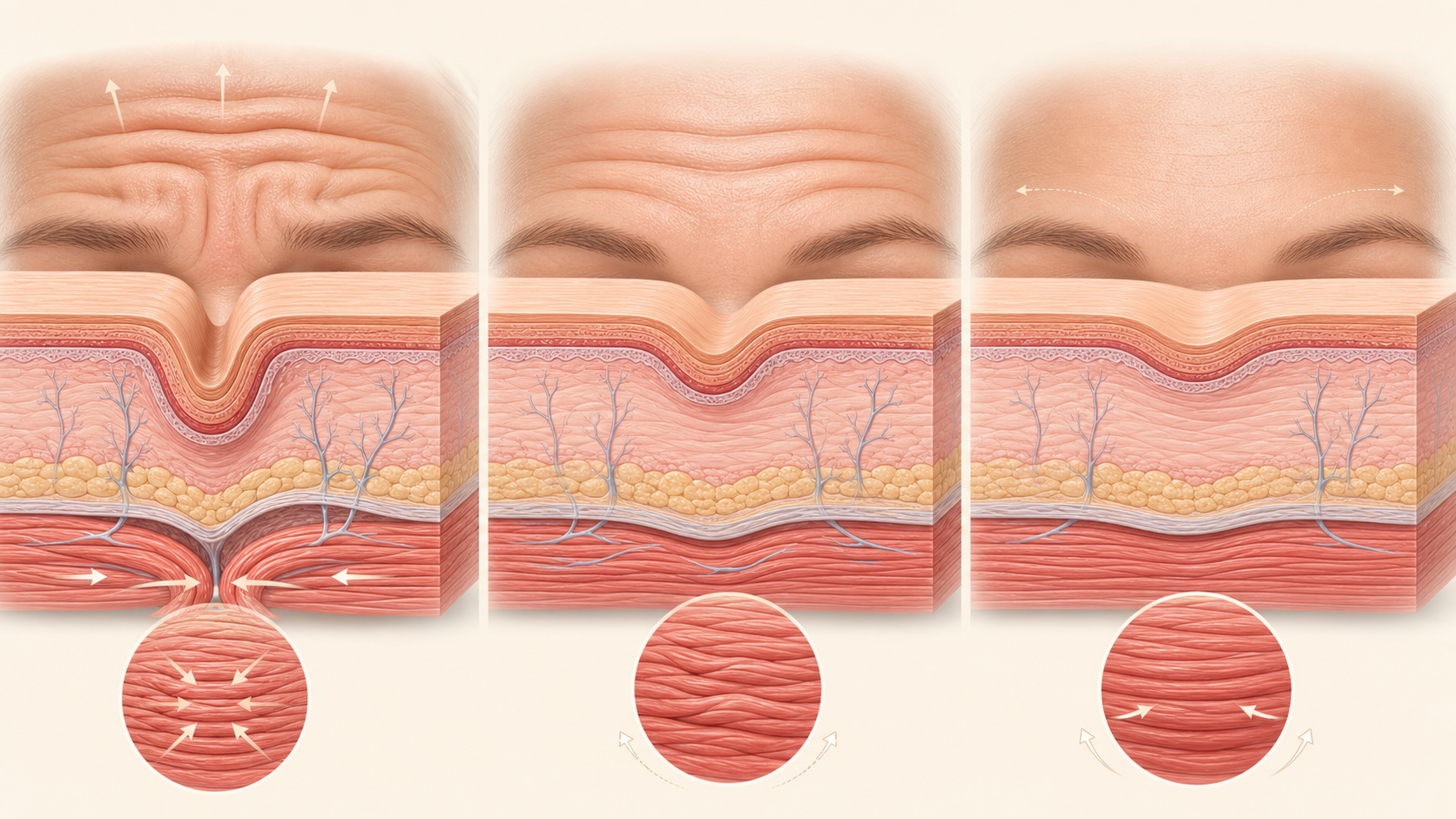
When you furrow your brows or raise your forehead, the skin folds. At first, these are wrinkles that disappear when your face relaxes (dynamic wrinkles). When the same area folds repeatedly over a long time and the dermis loses elasticity due to UV exposure, smoking, and skin aging, they can turn into wrinkles that remain even when your face is at rest (static wrinkles).
This process is not determined by age alone. The size and direction of the muscles, the position of the eyebrows and eyelids, skin thickness, expression habits, and UV-induced skin aging all play a role. That is why, even at the same age of 25, some people develop deep lines between the brows, while some people in their 40s show almost no wrinkles when their face is relaxed.
Effects and limitations of botulinum toxin (Botox)
Botulinum toxin type A, used for cosmetic purposes, inhibits the release of the signaling substance (acetylcholine) at nerve endings that makes muscles move, weakening contraction of the injected muscle for a period of time. Because the force that repeatedly folds the skin is reduced, wrinkles that appear with facial expressions are softened, and shallow wrinkles visible at rest may also become smoother. In a study that measured the area between the brows of 21 people using 3D photography, an index representing the unevenness of the skin surface between the brows at rest decreased by 17% at day 30 and 24% at day 90. However, this was a small study with no comparison group.
In addition, botulinum toxin is a treatment that reduces muscle movement; it is distinct from reversing UV-damaged collagen, restoring lost volume, or eliminating all fine lines. Its effects wear off over time and vary depending on the individual, product, area, and dose.
Research on the wrinkle-preventing effect of botulinum toxin (Botox)
The case of identical twins treated differently for 13 years
The most frequently cited source is a 2006 case report comparing one pair of identical twin sisters. One received treatment on the forehead and between the brows 2–3 times a year for about 13 years, while the other was treated only twice. The twin who was treated regularly showed less visible forehead and frown lines at rest.
Although it is meaningful that two people with a similar genetic background were observed over a long period, the case involves only one pair. Whether the same results would appear in other people therefore needs to be confirmed by studies involving more people.
Studies observing wrinkle changes after repeated treatment
In a study of adults who already had frown lines and received three repeated treatments, the proportion of people with no visible wrinkles at rest increased with each treatment. This study was sponsored by the manufacturer. In another study in which 45 women aged 30–50 were treated every 4 months for 20 months, improvement was also observed up to 6 months after the last injection.
However, these studies involved adults who already had wrinkles. Whether starting treatment in your 20s, without wrinkles, prevents wrinkles decades later is therefore a separate question from these studies.
Approved uses
The approved uses of botulinum toxin products vary by product and country, and mainly cover the temporary improvement of moderate to severe wrinkles in adults. Preventive treatment started at a specific age is not among the approved uses.
When botulinum toxin (Botox) treatment may be considered in your 20s
Even in your 20s, treatment may be considered depending on your condition. If a particular area folds very strongly when you make facial expressions, if wrinkles are starting to remain at rest, or if that change is a clear concern for you, you can consult a medical professional regardless of age. On the other hand, if you have almost no expression lines and want to start only out of worry that wrinkles might form, there is not yet sufficient evidence that you need to rush to start.
The forehead in particular depends on the balance between the forehead muscle that raises the eyebrows and the frown muscles between the brows that lower them. If everyone is treated in the same way, people with heavy eyelids or who raise their eyebrows to keep their field of vision clear may feel that their eyes become heavier. To preserve natural expressions, it is best to consider facial structure, muscle movement, and injection sites and doses together.
What to check before repeated treatments
- Because the effect is temporary, repeated treatments may be needed to maintain it.
- In a study analyzing 1,415 people who received repeated injections of one botulinum toxin type A product for frown lines over 24 months, the rate of side effects did not increase with repeated treatments. During the study, 66% of participants experienced at least one adverse symptom, including symptoms unrelated to the treatment, but most were mild or moderate, and 87% of the reported symptoms were judged to be unrelated or unlikely to be related to the treatment.
- In rare cases, antibodies may form and reduce the effect, so it is best not to increase the dose without an examination just because the effect seems to have diminished.
- Pain at the injection site, bruising, headache, a tight feeling, or awkward-looking expressions may occur.
- Depending on the area, drooping of the eyelids or eyebrows, asymmetry, or unwanted muscle weakness may occur.
- Before treatment, tell your medical provider about any neuromuscular disease, whether you are pregnant or breastfeeding, any medications you are taking, and your previous treatment history.
- Symptoms suggesting that the effect has spread, such as problems swallowing, speaking, or breathing, are rare, but if they occur, seek care without delay from the clinic where you were treated or a relevant specialist.
Questions to consider when deciding on treatment
- Do wrinkles remain even when my face is at rest?
- Which expressions do I want to keep, and how much?
- Can I accept a temporary effect and the cost of repeated treatments?
- Am I also managing other causes of wrinkles, such as through sun protection and not smoking?
Caution is warranted both in saying that botulinum toxin (Botox) prevents future wrinkles and in saying that it is pointless in your 20s. Botulinum toxin is a treatment that adjusts current muscle movement for a period of time, and there is not yet clear evidence for starting or postponing it based solely on being in your 20s.
Therefore, it is important to decide on treatment after reviewing your current wrinkle pattern, the balance of your facial muscles, and the expressions you want with a medical professional.
Frequently Asked Questions
- Will getting botulinum toxin (Botox) in my 20s mean fewer wrinkles later?
- There are research findings that wrinkles at rest were less visible in people who received repeated treatments. Because these come from a case comparing one pair of identical twins over about 13 years and from studies of adults who already had frown lines, the long-term preventive effect in people in their 20s without wrinkles needs further confirmation. The effect is temporary, and side effects such as bruising and headache may occur.
- At what age is it best to start botulinum toxin (Botox)?
- Research has not established a good age to start botulinum toxin (Botox). Rather than going by age, it is best to decide on treatment after evaluating, together with a medical professional, the wrinkles that form with facial expressions, the wrinkles that remain at rest, and the position of your eyebrows and eyelids.
- Is it OK to get botulinum toxin (Botox) preventively if I have almost no wrinkles?
- If you have almost no wrinkles, there is not yet enough evidence that you need to rush to start just because you are worried. However, if a particular area folds strongly when you make facial expressions, or wrinkles have started to remain at rest, you can consult a medical professional even in your 20s.
- Is it safe to get botulinum toxin (Botox) repeatedly over a long time?
- Repeated treatment is possible, but each time, the dose and interval should be decided after reviewing the previous effect and any side effects with a medical professional. In a study of repeated injections of one product for frown lines over 2 years, the rate of adverse symptoms did not increase with more sessions, but the study did not cover longer periods or other products, and in rare cases the effect may decrease due to antibodies or other factors. Bruising, headache, and similar effects may occur, and in rare cases problems with swallowing, speaking, or breathing require immediate medical care, so get a detailed explanation from a medical professional before treatment.
- Can botulinum toxin (Botox) in the forehead make my eyes feel heavy?
- Botulinum toxin (Botox) in the forehead can weaken the force that raises the eyebrows, causing the brows to lower and the eyes to feel heavy, and this usually resolves as the effect wears off. It can be more noticeable if you habitually raise your eyebrows to open your eyes or if your eyelids droop, so tell your medical provider before treatment so the injection sites and doses can be adjusted.
References
- 1.U.S. Food and Drug Administration. BOTOX Cosmetic (onabotulinumtoxinA) Prescribing Information. Revised October 2024.
- 2.Binder WJ. Long-term effects of botulinum toxin type A (Botox) on facial lines: a comparison in identical twins. Arch Facial Plast Surg. 2006;8(6):426-431.
- 3.Carruthers A, Carruthers J, Fagien S, et al. Repeated OnabotulinumtoxinA Treatment of Glabellar Lines at Rest Over Three Treatment Cycles. Dermatol Surg. 2016;42(9):1094-1101.
- 4.Dailey RA, Philip A, Tardie G. Long-term treatment of glabellar rhytides using onabotulinumtoxinA. Dermatol Surg. 2011;37(7):918-928.
- 5.Rappl T, Wurzer P, May S, et al. Three-Dimensional Evaluation of Static and Dynamic Effects of Botulinum Toxin A on Glabellar Frown Lines. Aesthetic Plast Surg. 2019;43(1):206-212.
- 6.Cohen JL, Schlessinger J, Cox SE, et al. An analysis of the long-term safety data of repeat administrations of botulinum neurotoxin type A-ABO for the treatment of glabellar lines. Aesthet Surg J. 2009;29(6 Suppl):S43-S49.
Medical Mentor
 Dr. Roh Kyoung Soo
 Dr. Park Tae Wook


