


How do Ultherapy Prime and Thermage FLX differ?
2026.10.20Related procedures
Ultherapy Prime and Thermage FLX are both referred to as lifting devices, but rather than seeing one as better than the other, it is better to understand them as devices that work in different ways. The difference between the two devices known so far lies less in how large or small their effects are and more in which layer of the skin, and in what form, they deliver heat energy. Ultherapy Prime focuses ultrasound onto a single point to create very small thermal coagulation points in a deep layer, while Thermage FLX broadly heats the area through which a radiofrequency (RF) current passes. Depending on this difference, the skin layers affected, the changes that appear, and the types of side effects that may occur can also differ.
Therefore, rather than asking which device is better, it is important to consider which approach suits the condition of the skin and tissue, and, if the two approaches are used together, which order is best.
In fact, a study that applied the two approaches separately to the left and right sides of the same person's face also looked not at which side was better but at the order in which to use them together. Below, based on published papers, we summarize how the two devices work, the degree of improvement reported, side effects, and points to consider when choosing.
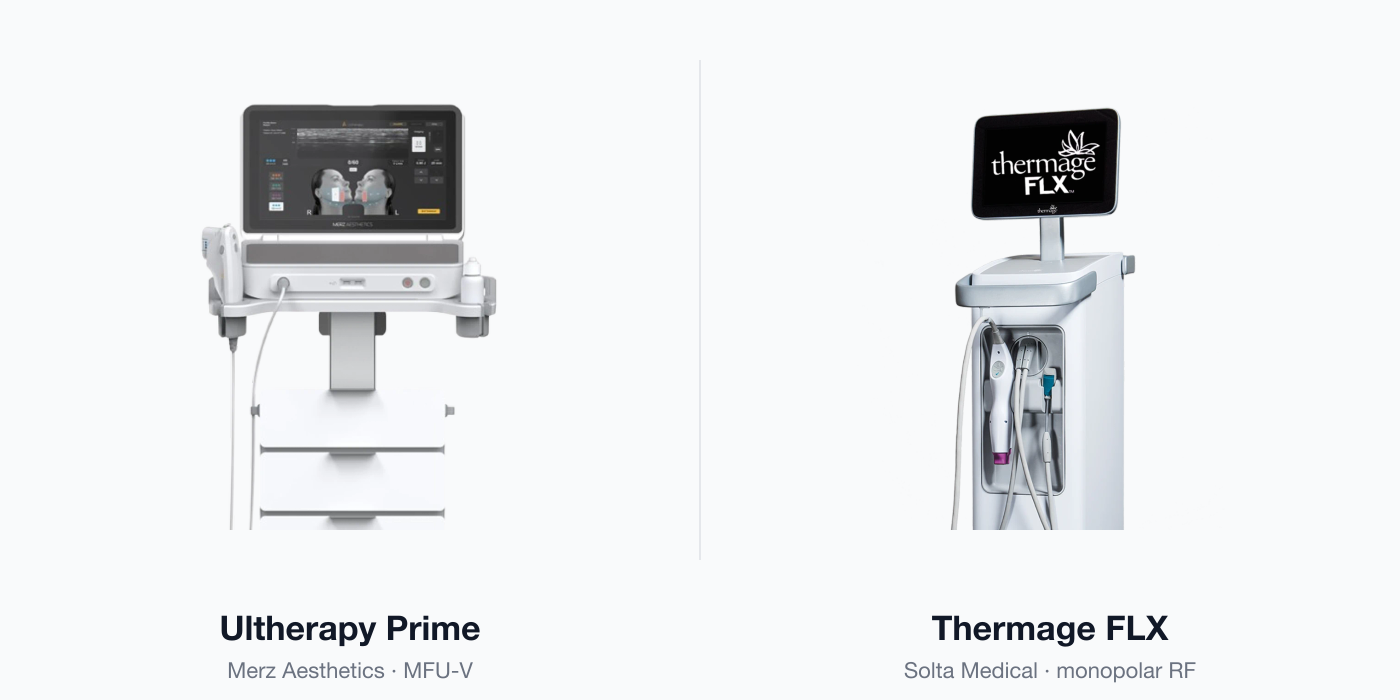
How do Ultherapy Prime and Thermage FLX work?
Ultherapy Prime's micro-focused ultrasound (MFU-V)
Ultherapy Prime is a micro-focused ultrasound (MFU-V) device that checks the skin layers with real-time imaging. Merz named this feature Deep SEE*. When ultrasound is focused onto a single point, tissue coagulates instantaneously only at that focal point. In a study that confirmed this principle in human skin tissue samples (Laubach 2008), coagulation could be created only inside the skin using an experimental device at 7.5MHz and up to 45W. In a study of facial tissue from donated cadavers (White 2007), ultrasound was delivered along 202 lines after the skin layers were checked with ultrasound imaging, and thermal injury zones could be created only in the fascial layer (SMAS) while sparing surrounding layers such as the epidermis, reaching a depth of up to 7.8mm.
In a study that examined pig skin tissue (Marquardt 2025), the thermal coagulation points created in this way were observed on day 14 after treatment as elongated shapes about 500 × 200µm in size. Thermal coagulation points were created at depths of 1.5mm, 3.0mm, and 4.5mm, but because pig skin has no fascial layer, the researchers analyzed only the 1.5mm and 3.0mm results. Most of the authors of this study are affiliated with the device manufacturer (Merz). Ultherapy is designed to deliver energy point by point rather than across an entire surface, so that energy passes through the skin surface and is concentrated in the fascial layer.
Deep SEE* refers to the feature that checks the thickness of the skin layers with real-time ultrasound imaging before treatment. Because the thickness of the skin, fat, and fascial layer differs by area and by person, checking with imaging and deciding at which depth to deliver ultrasound energy is an important part of this approach. The manufacturer (Merz Aesthetics) announced that Ultherapy Prime has a 35% larger screen and that, based on a practitioner survey, system speed is on average 20% faster. The scope of U.S. Food and Drug Administration (FDA) clearance covers eyebrow lifting, lifting of lax tissue under the chin and on the neck, and improvement of wrinkles on the upper chest (décolletage), and the 2025 clearance document (K250418) also includes improvement of skin laxity on the abdomen and arms.
So how does creating thermal coagulation points produce a lifting effect? Most of us probably remember using a magnifying glass as children to focus light onto a single point and burn something. By the same principle, ultrasound is used, without damaging the visible skin surface, to 'burn' the fascial layer (SMAS) inside the skin, which firmly anchors the outer and inner parts of the skin, thereby 'denaturing' the proteins of structures inside the skin, and as a result these gather to 'contract' the support structure inside the skin. In this way, on the outside of the skin, a pulling effect can be created just as we designed and performed the treatment.
Lifting treatments that use ultrasound, like Ultherapy, are called HIFU. In fact, there are a great many devices that use ultrasound to create a lifting effect. However, the reason Ultherapy stands out among those many lifting devices is that it 'sees' while it 'delivers'. As mentioned above, everyone's skin is different depending on sex, age, ethnicity, and living environment. Therefore, for a more effective treatment, checking where each person's fascial layer (SMAS) is located and delivering energy to match that depth determines the effect of the treatment.
Thermage FLX's monopolar radiofrequency (RF)
Radiofrequency does not create a focal point. According to the manufacturer, Thermage FLX passes a 6.78MHz current to broadly heat the area the current passes through, from the dermis to the fat layer beneath the skin, while protecting the skin surface (epidermis) with cooling. In a study that examined tissue changes with the first-generation device (ThermaCool) (Zelickson 2004), changes in which collagen fibers became thicker and their boundaries less distinct were observed down to a depth of 6mm in bovine tendon tissue. In human abdominal skin, the same changes were confirmed in scattered areas under an electron microscope, and the gene signal (mRNA) for producing type I collagen increased.
Even with broad heating, the pattern in which heat spreads can differ depending on the tissue. In a computer modeling and pig skin study comparing 6.78MHz and 2MHz monopolar radiofrequency (Ko 2025), in the modeling 6.78MHz raised the temperature over a narrower range along the fibrous tissue between fat lobules beneath the skin (fibrous septa), while 2MHz heated the entire fat layer broadly and deeply. However, this study did not use the Thermage FLX device itself, and some of the authors are affiliated with another radiofrequency device manufacturer (Cynosure Lutronic). Therefore, it is appropriate to interpret it only as showing the possibility that the frequency used by Thermage FLX may act along the fibrous tissue supporting the fat rather than on the fat itself. In the same study, no findings of fat cell death were observed even when the two frequencies were used together.
Compared with the previous generation, Thermage FLX differs less in the strength of its energy than in the way it controls energy delivery. According to the manufacturer, the AccuREP feature measures the electrical resistance of the skin tissue at each treatment point to adjust output, and a 4.0cm² tip with vibration and cooling functions controls treatment speed and pain.
Then how does Thermage create a lifting effect? In fact, the word 'lifting' may be suitable for describing the effect of the treatment we perform, but in terms of how it works, it is far from accurate. We think the word 'tightening' is more appropriate and correct. We need to look at what the 'heat' that enters our skin does. There are two effects expected from receiving Thermage. The first is increasing elasticity by promoting skin regeneration through heat, and the second is reducing fat volume through heat to shape the facial form we want, the contour.
If you have ever cooked meat on a grill, you will know that fat is the first to be altered by heat. That is exactly why we explain that, by repeatedly delivering 'heat' energy to a given area, it may be possible to improve skin elasticity and wrinkles through skin regeneration while at the same time refining protruding areas such as the deep cheeks and jaw.
How much lifting effect has been confirmed in studies?
Results showing that both approaches are effective have been reported repeatedly in multiple studies. However, even in studies that measured distances such as eyebrow height, the changes were on the order of millimeters, and because each study evaluated different areas, measures, and time points, it is better to look at effect size through each study's results rather than as a single figure.
First, here is my comparison of the effects as a practitioner
The two treatments are grouped together under the same label of 'lifting', but the means, methods, and energy that produce their results are completely different. Depending on the shape of the face and the skin a person has, either Ultherapy or Thermage may be more suitable. However, in most cases a single treatment was not enough to address skin concerns caused by aging. Ultherapy may be more effective for changes in shape and wrinkles caused by a loss of elasticity, but treating a hollow area located right next to the area of concern can make that hollow deeper. Conversely, Thermage may be appropriate for evenly increasing elasticity over a wide area, but it may not be enough to address concerns in a specific area. In other words, this is why careful time must be taken to design the two treatments to fit the shape of the face and to adjust the number of shots and the energy.
Studies on ultrasound lifting
The studies below were conducted with earlier devices released before Ultherapy Prime or with experimental devices. Therefore, they are best viewed separately from results that directly evaluate the effect of Ultherapy Prime itself, and the fact that they are small studies should also be taken into account.
In a study that treated the entire face and neck once in 35 people and evaluated them 90 days later (Alam 2010), three evaluators who did not know which of the before-and-after photos was taken after treatment identified clinically significant eyebrow lifting in 30 of 35 people (86%). The actually measured eyebrow elevation was 1.7mm on average.
In a study of 22 Korean people (Suh 2011), the nasolabial folds and jawline improved objectively in all participants after a single treatment, and 77% and 73% of participants, respectively, themselves answered that they had “improved a lot”. Biopsies from 11 people confirmed increases in dermal collagen and dermal thickness and changes in the arrangement of elastic fibers in the deep dermis.
In a study that delivered 800 lines to 25 Asian people (Lu 2017), three-dimensional measurements showed that on day 90 the eyebrows rose by an average of 0.47mm and the submental lifting measure also improved significantly. However, by day 180 the statistically significant differences in both measures had disappeared. The researchers also suggested combining it with other treatments or receiving an additional treatment 3 months after the first.
Studies on radiofrequency lifting
In a study that treated 86 people once with monopolar radiofrequency and followed them for 6 months (Fitzpatrick 2003), when periorbital photos presented so that evaluators could not tell before from after were compared, wrinkle scores improved by 1 point or more in 99 of 119 treated areas (83.2%), and 40 of 65 eyebrows (61.5%) rose by 0.5mm or more. However, improvement as judged by the treating physicians without pre-treatment photos was only 48 of 166 areas (28.9%), and 41 of 82 participants (50%) said they were satisfied.
In addition, these results come from a study that used a previous-generation device (ThermaCool), not Thermage FLX. Within the scope reviewed in this article, we did not find any large-scale comparative clinical study on Thermage FLX itself, and the data on Thermage FLX are at the level of user experience surveys. In a survey of 52 Korean dermatologists (Suh 2020), compared with the previous generation (CPT), 57.4% answered “more effective”, 66.0% “shorter treatment time”, and 25.5% “more painful”. Therefore, rather than applying previous-generation study results directly to the effect size of Thermage FLX, it is better to look at it together with studies that accumulate in the future.
Studies that used radiofrequency and ultrasound together
In a study of 24 Korean adults (Choi 2025), one side of the face was treated with radiofrequency followed by ultrasound, and the other side with ultrasound followed by radiofrequency, and evaluations were made at 30 and 90 days. However, whether the devices used are the same as the two devices in this article cannot be confirmed from the study abstract. Both orders showed improvement with few side effects, and in three-dimensional measurements the reduction in wrinkles was slightly greater on the side treated with radiofrequency first. Biopsies showed increases in collagen types I, III, and IV and laminin on both sides, with no clear difference according to order.
However, this was a study of 24 people, and more research is needed to determine a treatment order that suits everyone. Therefore, this study can be seen as data that examined the order of treatment when using radiofrequency and ultrasound together.
How many side effects have been reported for the two devices?
For ultrasound lifting, in a study that pooled and analyzed data from 19 papers and 506 patients (Humphrey 2025), the most common side effects were temporary swelling, redness, and post-treatment pain, and the serious side effect reported in the academic literature was 1 case of atrophy of the tissue beneath the skin. The same study also examined 106 reports submitted to the U.S. Food and Drug Administration (FDA) adverse event reporting database (MAUDE), in which fat atrophy, nerve-related symptoms (nerve injury, partial loss of sensation, abnormal sensation, drooping eyelids), and scarring were reported most often. However, these data cannot be used to calculate how often side effects occur. Therefore, it is appropriate to view them as data for knowing the types of side effects that may occur rather than their frequency.
For radiofrequency lifting, in the Fitzpatrick 2003 study mentioned above, second-degree burns occurred 21 times (0.36%) over 5,858 deliveries of radiofrequency energy, and 3 people had scars remaining at the 6-month point. Because these are results from a previous-generation device, they need to be viewed separately from the side effect rate of Thermage FLX, but it is good to be aware that such side effects can occur.
It is better to understand both approaches not as replacements for surgical lifting but as treatments from which a different range of change is expected. In studies that measured distances, the changes were on the order of millimeters, and in the Lu 2017 study, the changes confirmed at 3 months did not show a statistically significant difference at 6 months. Therefore, repeat treatment may be needed to maintain the effect.
Points to consider when choosing between Ultherapy Prime and Thermage FLX
Depending on whether your concern is a sagging contour or the elasticity and texture of a wide area, it is good to check with your medical team which of the two approaches, which act at different depths, suits you.
If you have both concerns, it is good to check with your medical team whether you need to receive both treatments together and what the expected benefits and risks are.
In many clinical studies, improvement was mainly evaluated about 3 months (90 days) after treatment. Therefore, it is good to check the effect and whether additional treatment is needed with your medical team around this time.
The thickness of the skin, fat, and fascial layer can differ by area and by person. Therefore, it is good to check the skin layers with ultrasound imaging before treatment.
Rather than seeing one of Ultherapy Prime and Thermage FLX as more effective or seeing the two devices as producing the same effect, it is natural to understand them as two treatments that work in different ways. This article summarizes the working principles and reported results of the two devices based on published papers, and it is not an individual diagnosis or a treatment recommendation.
Therefore, it is important to check the condition of your skin, fat, and muscle layers, the cause of sagging, and your past medical and treatment history with your medical team, and to decide on the right treatment and combination. The papers cited in the text are listed in the “References” below.
References
- 1.White WM, Makin IRS, Barthe PG, Slayton MH, Gliklich RE. Selective creation of thermal injury zones in the superficial musculoaponeurotic system using intense ultrasound therapy: a new target for noninvasive facial rejuvenation. Arch Facial Plast Surg. 2007;9(1):22-29.
- 2.Laubach HJ, Makin IRS, Barthe PG, Slayton MH, Manstein D. Intense focused ultrasound: evaluation of a new treatment modality for precise microcoagulation within the skin. Dermatol Surg. 2008;34(5):727-734.
- 3.Alam M, White LE, Martin N, Witherspoon J, Yoo S, West DP. Ultrasound tightening of facial and neck skin: a rater-blinded prospective cohort study. J Am Acad Dermatol. 2010;62(2):262-269.
- 4.Suh DH, et al. Intense focused ultrasound tightening in Asian skin: clinical and pathologic results. Dermatol Surg. 2011;37(11):1595-1602.
- 5.Lu PH, Yang CH, Chang YC. Quantitative analysis of face and neck skin tightening by microfocused ultrasound with visualization in Asians. Dermatol Surg. 2017;43(11):1332-1338.
- 6.Marquardt K, Hartmann C, Wegener F, et al. Microfocused ultrasound with visualization induces remodeling of collagen and elastin within the skin. J Cosmet Dermatol. 2025;24(1):e16638.
- 7.Humphrey VS, Rambhia PH, Gmyrek R, Chapas A. Microfocused ultrasound with visualization: a systematic review of adverse events and risk of subsequent facelift compromise. Dermatol Surg. 2025;51(4):424-429.
- 8.Fitzpatrick R, Geronemus R, Goldberg D, Kaminer M, Kilmer S, Ruiz-Esparza J. Multicenter study of noninvasive radiofrequency for periorbital tissue tightening. Lasers Surg Med. 2003;33(4):232-242.
- 9.Zelickson BD, Kist D, Bernstein E, et al. Histological and ultrastructural evaluation of the effects of a radiofrequency-based nonablative dermal remodeling device: a pilot study. Arch Dermatol. 2004;140(2):204-209.
- 10.Ko K, Ryu HG, Park J, et al. Computational modeling and histologic analysis of 6.78- and 2-MHz monopolar radiofrequency-induced thermal reactions. Lasers Med Sci. 2025;40(1):501.
- 11.Choi WJ, Jang YJ, Jung DY, Song BH, Park EJ, Kim KJ, Kim KH. Comparative study of monopolar radiofrequency and high-intensity focused ultrasound for facial rejuvenation: a split-face approach. Dermatol Surg. 2025;51(9S):S49-S53.
- 12.Suh DH, Hong ES, Kim HJ, Lee SJ, Kim HS. A survey on monopolar radiofrequency treatment: the latest update. Dermatol Ther. 2020;33(6):e14284.
- 13.Merz Aesthetics. Ultherapy PRIME platform launch announcement (press release). September 23, 2024.
- 14.U.S. Food and Drug Administration. Ulthera System with Ultherapy PRIME Platform, 510(k) Premarket Notification K250418. 2025.
Medical Mentor
 Dr. Roh Kyoung Soo
 Dr. Park Tae Wook


