


Itchy, tight skin in winter: is moisturizer enough?
2026.11.26Related procedures
Keeping up with moisturizer and changing how you wash can help with skin that feels tight and itchy in winter, but if the itching lasts or your skin cracks and turns red, moisturizing alone may not be enough. Cold, dry air weakens the protective outer layer of the skin (the skin barrier), letting moisture escape more easily. There is not yet enough evidence that any particular moisturizer works better than others, so the basic recommendation is to apply moisturizer generously and consistently.
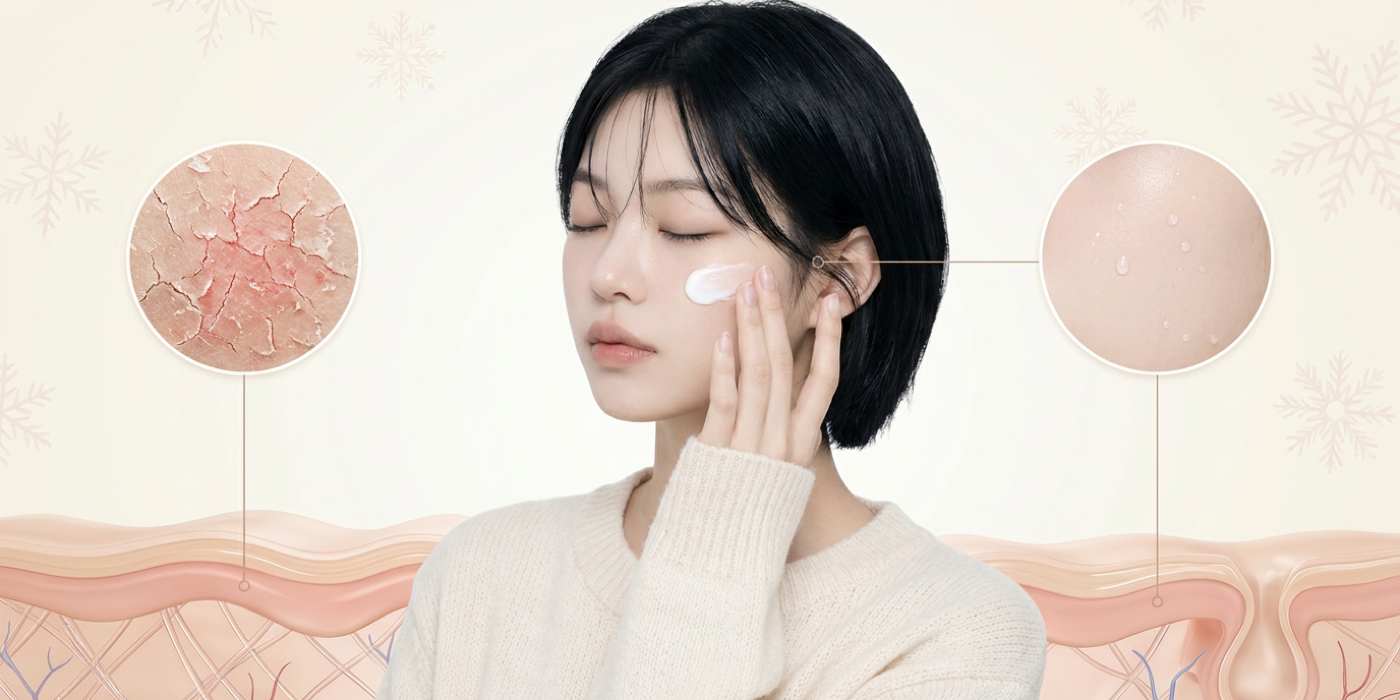
The key to managing dry winter skin is not a special ingredient but moisturizing right after washing and reapplying consistently, and itching that does not improve with moisturizing is best checked by a medical professional to find the cause.
Why does skin get drier in winter?
The amount of moisture the air can hold changes with temperature. On cold winter days the air becomes much less humid, so moisture is drawn from the skin into the air, and this is the main reason skin feels dry. In addition, when temperature and humidity drop, the skin barrier works less well, so moisture escapes from the skin more easily and the skin can become sensitive to even small irritations. That is why skin that is usually fine may feel tight or itchy in winter.
A review of how humidity and temperature affect the skin concluded that low humidity and low temperature generally weaken skin barrier function, and that skin conditions such as atopic dermatitis and psoriasis tend to worsen in cold, dry weather. In a study that measured the skin of 72 young women across all four seasons, moisture and oil in the cheek skin were lowest in winter, and the amount of water lost from the skin was highest in winter. This study involved young women in a single region, and seasonal changes vary between studies, so results may differ from person to person.
In a Korean study in which participants stayed in a heated indoor room for 6 hours, water loss from the skin of the arm increased. However, this was a short study conducted by a corporate research institute, so it is best seen as reference material.
Which moisturizer ingredients should I choose?
Evidence that any particular moisturizer works better than others has not yet built up enough. Because each ingredient plays a different role, it is best to choose a product that suits your skin and that you can apply consistently.
A Cochrane review of 77 clinical studies (6,603 people) with eczema found that groups using moisturizers had less severe symptoms and less itching than comparison groups that used no moisturizer or a cream without active ingredients, and had fewer flare-ups. However, comparisons between different moisturizers found no reliable evidence that one product was better than another. Because this review involved people with eczema, the same size of effect should not be expected for ordinary winter dryness.
Ingredients can be understood by the role they play.
Ingredients that hold on to moisture, such as glycerin
Ingredients that cover the skin surface to reduce moisture loss, such as petrolatum
Ingredients that hold moisture and soften dead skin, such as urea
Ingredients studied for supporting the skin's protective layer, such as dexpanthenol (panthenol)
In a clinical study of 51 people with dry skin, petrolatum contributed to reducing water loss and glycerin to increasing skin hydration. Urea is used mainly for moisturizing at concentrations of 10% or less and for dissolving dead skin at higher concentrations, and in studies of people with eczema, side effects such as stinging were reported more often in groups using urea cream. There are older studies showing that dexpanthenol increased skin hydration and reduced water loss, but it is more natural to see it as one of many moisturizing ingredients. Products containing fragrance or alcohol can irritate the skin, so it is best to avoid them.
That said, after talking with many people in clinical practice and looking at their symptoms, what I consider most important is
not changing your skincare products often. Applying products to protect your skin's moisture can sometimes be felt as stress by the skin. In most cases, sticking with a moisturizer you have used well for a long time helps improve and maintain your skin's condition. When you want to try a new product, the safest approach is to test it on a small area of the face first and widen the area gradually if there are no problems.
When and how much moisturizer should I apply?
It is recommended to apply moisturizer right after washing, while the skin is still slightly damp, and to reapply several times a day. Creams or ointments may help keep moisture in longer than lotions.
The American Academy of Dermatology (AAD) advises patting the skin dry with a towel after washing and applying a fragrance-free moisturizer while the skin is still damp. Guidelines from the Korean Atopic Dermatitis Association acknowledge that the evidence is limited but still recommend that people with atopic dermatitis apply moisturizer generously at least twice a day, with adults using 250 g or more per week. People without atopic dermatitis do not necessarily need the same amount, but in winter it is better to apply more generously than you might think.
In a small study in which 5 children with atopic dermatitis and 5 with healthy skin each tried four different routines, bathing without applying moisturizer could actually lower skin hydration, and applying moisturizer alone gave the highest skin hydration. On the other hand, there was little difference between applying moisturizer right after bathing and applying it a little later. So rather than having to apply it within a few minutes, the habit of never skipping moisturizer after washing matters more.
Do washing habits affect dry skin?
Washing for a long time with hot water or using a lot of cleanser makes the skin more likely to dry out. It is recommended to wash briefly, for about 5–10 minutes, with lukewarm water and to use a mild cleanser only where needed.
Wash with lukewarm water within 5–10 minutes.
Do not scrub off dead skin or rub hard.
Choose a mild cleanser and use it only where needed.
After washing, pat dry with a towel and apply moisturizer right away.
If you use a humidifier, clean it often so that mold does not grow.
In a clinical study of 52 healthy adults, the group that washed their face with warm water for 10 days showed increased water loss from the skin, while the group that washed with cool water showed no clear change. In a small experiment in which an irritating ingredient was applied to the skin together with water at different temperatures, irritation was also greater the warmer the water. Both studies had few participants, so more research is needed before applying the results directly to everyday showering habits.
When moisturizer is not enough and you should see a doctor
If itching continues despite regular moisturizing, if your skin cracks and bleeds, or if red eczema appears, it is a good idea to be examined by a medical professional. This is because moisturizer is not a medicine that calms inflammation that has already developed.
When itching continues despite regular moisturizing
When the skin on the shins or arms turns white and flaky and then cracks in a net-like pattern
When cracked skin bleeds or oozes
When red, bumpy eczema appears
When your whole body itches without a rash
Itchy skin on the shins that looks like a cracked, dried-up riverbed may be asteatotic eczema (winter eczema), which often appears in winter, and bacterial infection can also occur through the cracks. A review of studies in older adults reported that more than half of older people experience dry skin. However, itching can also be caused by medications such as blood pressure drugs or by other conditions in the body, so it is best to look into the cause of long-lasting itching as well.
Can hyaluronic acid injections help dry skin?
There are cosmetic studies showing that hyaluronic acid injections, in which hyaluronic acid is injected directly into the skin, increased hydration levels in adults' facial skin. However, they have not been studied as a treatment for winter dryness or eczema.
A review that combined 6 studies of hyaluronic acid injections found that skin hydration levels improved, but there was no statistically significant difference in elasticity compared with comparison groups, and it concluded that more research is needed. In a clinical study of 448 people, the group that received injections also had higher facial skin hydration levels than the group that did not. Both studies aimed to improve skin aging. So hyaluronic acid injections are not a substitute for everyday moisturizing care, and it is more natural to see them as one option you can discuss with a medical professional if you are interested.
What to remember about managing dry winter skin
Rather than trying to solve dry winter skin with a single good moisturizer, it is better to approach it through daily care that changes both your washing habits and your moisturizing routine. The basics are to wash briefly with lukewarm water and apply moisturizer generously right after washing and several times throughout the day. If itching and cracking continue despite this care, please check with a medical professional whether eczema or another cause may be involved.
Frequently Asked Questions
- Does dexpanthenol (panthenol) cream help dry skin?
- Dexpanthenol (panthenol) is one of the moisturizing ingredients that studies have shown can increase skin hydration and reduce water loss. However, there is not yet enough evidence that any particular moisturizer works better than others, so the basic approach is to choose a product you can apply consistently without irritation.
- Should I use a lotion, cream, or ointment?
- For dry winter skin, creams or ointments may help keep moisture in longer than lotions. The American Academy of Dermatology (AAD) recommends creams or ointments over lotions and advises reapplying several times a day.
- Does using a humidifier help with dry skin?
- The American Academy of Dermatology (AAD) suggests running a humidifier while you sleep as one way to care for dry skin. However, it is important to clean it often so that mold does not grow.
- My shins are white, flaky, cracked, and itchy. Should I see a doctor?
- If itching and cracking do not improve with moisturizer, it is a good idea to be examined by a medical professional. Itchy shin skin that cracks in a net-like pattern may be asteatotic eczema, which often appears in winter, and the cracks can bleed or become infected.
References
- 1.Engebretsen KA, Johansen JD, Kezic S, et al. The effect of environmental humidity and temperature on skin barrier function and dermatitis. J Eur Acad Dermatol Venereol. 2016;30(2):223-49.
- 2.Yang J, Tu Y, Man MQ, et al. Seasonal variations of epidermal biophysical properties in Kunming, China: A self-controlled cohort study. Skin Res Technol. 2020;26(5):702-707.
- 3.Park EH, Jo DJ, Jeon HW, et al. Effects of winter indoor environment on the skin: Unveiling skin condition changes in Korea. Skin Res Technol. 2023;29(6):e13397.
- 4.van Zuuren EJ, Fedorowicz Z, Christensen R, et al. Emollients and moisturisers for eczema. Cochrane Database Syst Rev. 2017;2(2):CD012119.
- 5.Vaillant L, Georgescou G, Rivollier C, et al. Combined effects of glycerol and petrolatum in an emollient cream: A randomized, double-blind, crossover study in healthy volunteers with dry skin. J Cosmet Dermatol. 2020;19(6):1399-1403.
- 6.Celleno L. Topical urea in skincare: A review. Dermatol Ther. 2018;31(6):e12690.
- 7.Gehring W, Gloor M. Effect of topically applied dexpanthenol on epidermal barrier function and stratum corneum hydration. Results of a human in vivo study. Arzneimittelforschung. 2000;50(7):659-63.
- 8.Ko HC, Woo YR, Ko JY, et al. Consensus-Based Guidelines for the Treatment of Atopic Dermatitis in Korea (Part I): Basic Therapy, Topical Therapy, and Conventional Systemic Therapy. Ann Dermatol. 2025;37(4):201-215.
- 9.American Academy of Dermatology. Dermatologists' top tips for relieving dry skin.
- 10.Chiang C, Eichenfield LF. Quantitative assessment of combination bathing and moisturizing regimens on skin hydration in atopic dermatitis. Pediatr Dermatol. 2009;26(3):273-8.
- 11.Long S, Fenn K, Harvey K, et al. Cool versus warm water for facial cleansing: A randomized controlled clinical study of skin barrier, skin physiology, cleansing efficacy and water consumption. Int J Cosmet Sci. 2026. Epub ahead of print.
- 12.Berardesca E, Vignoli GP, Distante F, et al. Effects of water temperature on surfactant-induced skin irritation. Contact Dermatitis. 1995;32(2):83-7.
- 13.Berger TG, Shive M, Harper GM. Pruritus in the older patient: a clinical review. JAMA. 2013;310(22):2443-50.
- 14.Srivastava D, Sathe NC, Persaud Y. Asteatotic Eczema. In: StatPearls. Treasure Island (FL): StatPearls Publishing; 2026.
- 15.Zhou R, Yu M. The Effect of Local Hyaluronic Acid Injection on Skin Aging: A Systematic Review and Meta-Analysis. J Cosmet Dermatol. 2025;24(1):e16760.
- 16.Cheng H, Jiang M, Zhong S, et al. A Prospective, Multicenter, Randomized, Assessor-Blinded Study Assessing the Efficacy and Safety of Injectable Non-Cross-Linked Hyaluronic Acid for Improving Facial Skin Rejuvenation. Clin Cosmet Investig Dermatol. 2026;19:590699.
Medical Mentor
 Dr. Roh Kyoung Soo
 Dr. Kim Yeop


